
Architectural Lessons from the Classics #1
Lord of the Rings’ Rivendell

In the turbulent territory of Middle Earth, an Arcadian landscape lies by the river — a fertile, graceful valley sheltered by the slopes of the Misty Mountains. Nestled within it, interwoven with the trees, is a village, in communal proximity with the landscape.
This village is Rivendell. Secluded from the perils of Middle Earth, it is a haven for the Elves, embodying the utopia of a life lived in natural harmony, founded on the wisdom of a civilization that has endured through many eras and mastered the secrets of the natural world.
Originally from Germanic mythology, the depiction of Elves varies across Scandinavian, Anglo-Saxon, and Germanic traditions. J.R.R. Tolkien’s Elves share physical similarities with humans; however, they are semi-divine beings, gifted with eternal life and profound wisdom, custodians of the primordial languages of Middle Earth. Their almost-divine nature finds a parallel in their ethereal, white-toned stone dwellings they inhabit, structures that reflect their perpetuity, rationality, elegance and even a certain detachment.
Rivendell’s built environment draws inspiration from and becomes enmeshed with the rational geometries of nature. Finely engineered structures, often featuring colonnades and arches, welcome light through delicate, intricately detailed decorative elements, shaped organically to mirror the natural world.
Its predominant architectural style is, unsurprisingly, Art Nouveau, as this turn-of-the-century style was deeply inspired by nature, translating the organicity of life into flowing shapes and ornamental richness.
Art Nouveau can be contextualized as the beginning of the modern movement, marking the transition from the 19th to the 20th century. It descended from the Arts and Crafts movement, emerging in opposition to the revivalist trends of classical and Gothic styles (in the forms of Neoclassical and Neo-Gothic), which had dominated the previous centuries.
Even though Art Nouveau was a reaction against established canons in architecture, it was deeply rooted in the Gothic movement. The appreciation for nature was first embodied in Gothic designs - in this style, mostly used in religious buildings, columns often assumed the shape of trees, symbolic manifestations of the sacred in nature. Under the light of this style, structures gained elegance and verticality, based on rational geometries that became more efficient, rejecting the mass and staticity of classical composition.
During the Gothic Revival period in Europe, roughly during the 19th-century, its expression evolved in response to material innovations, primarily through the replacement of stone with steel structures and glass finishes, leading to the development of Modernity’s language.
Its accidental precursor was Eugène Viollet-le-Duc, a 19th-century architect whose work was crucial to the development of a structural paradigm later adopted as the basis of the modern movement: the principle of “structural honesty”, materialized in the separation between the skeleton (inner structure) and the envelope (outer shell) of buildings — a technical innovation that allowed for material economy and the vertical expansion of modern buildings. His vast expertise in the restoration of medieval heritage led him to argue that the Gothic architectural style was the closest to perfection, well-anchored in rationality and efficiency, and should serve as the foundation for a style liberated from classical canons.
The structural lessons from past styles, combined with the material innovations made possible by the Industrial Revolution at the turn of the 20th century, converged to create ideal conditions for the structural liberation of buildings. Freed from technical constraints, the democratization of architecture was finally possible.
Art Nouveau flourished as the first architectural style of Modernity and a break from traditional standards, rooted in the technical innovations of glass and steel. Its ornamental and decorative aesthetics marked a transitional phase, as subsequent styles progressively moved towards an abandonment of decoration in favor of functionality.
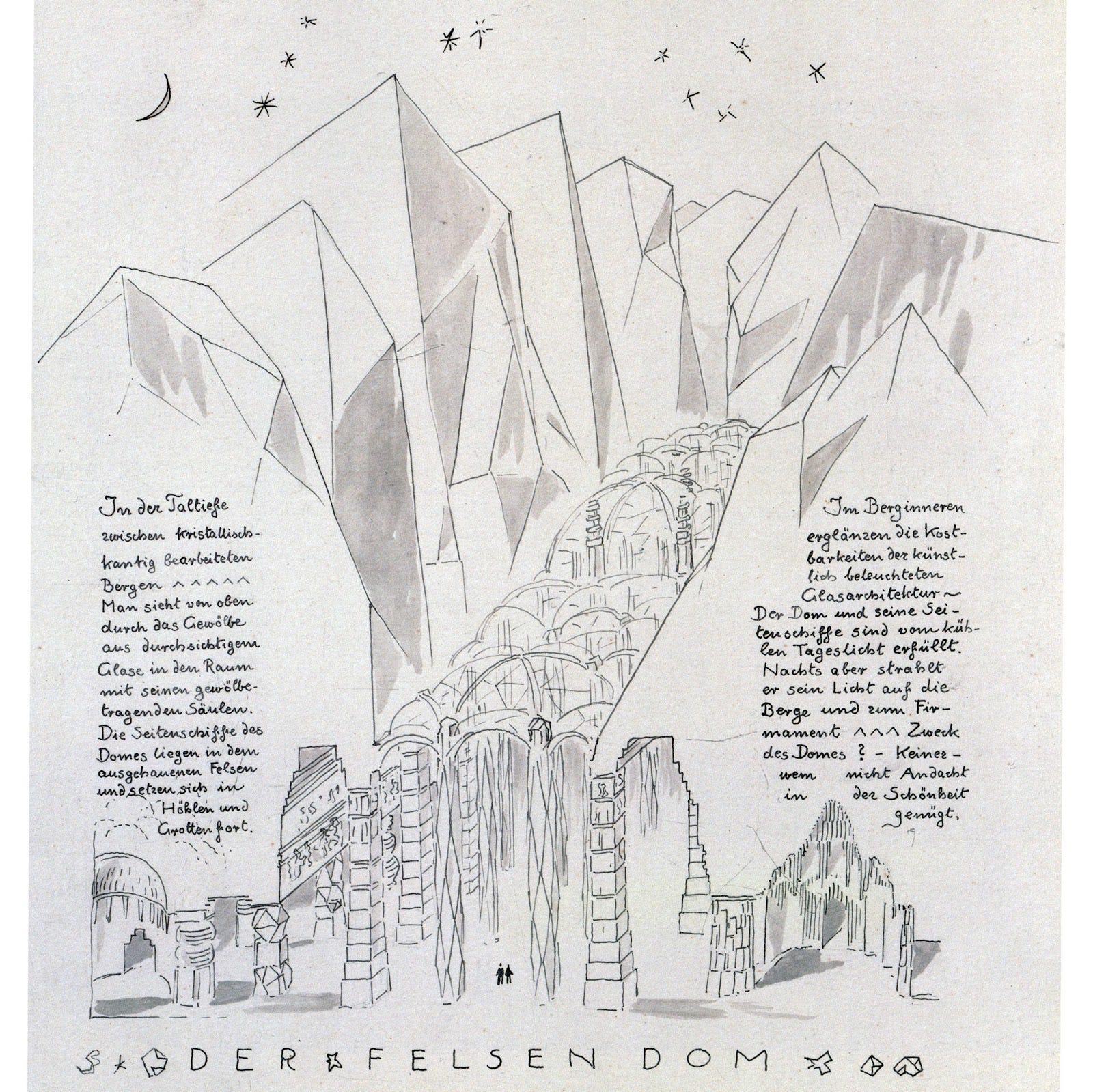
Glass became a symbol of a fairer, renewed, utopian world - as seen in Bruno Taut’s Alpine Architecture, an imagined landscape where mountains would be covered with glass structures.
His colleague, artist Paul Scheerbart, has even claimed:
The replacement of brick with glass in architecture will radically transform the world and elevate human culture to a higher state.
John Howe, who translated, with Allen Lee, Tolkien’s vision into visual forms for Peter Jackson’s film trilogy, has pointed Grindelwald, Switzerland, as a possible inspiration for Rivendell.
In Barcelona, under the name of Catalan Modernism, Art Nouveau flourished through the work of Antoni Gaudí. The architect drew inspiration from the colors and forms of nature to create architectural works of profound symbolic meaning. He applied organic lines to Gothic-inspired structures, decorated with mythical figures, stone, shells, and stained glass or mosaics. The columns of his Sagrada Familia Cathedral blossom like monumental trees, inviting visitors to reflect on the sacredness of life and nature, the interconnectedness of beings and spirit — to experience and revere the Divine in the details of existence.
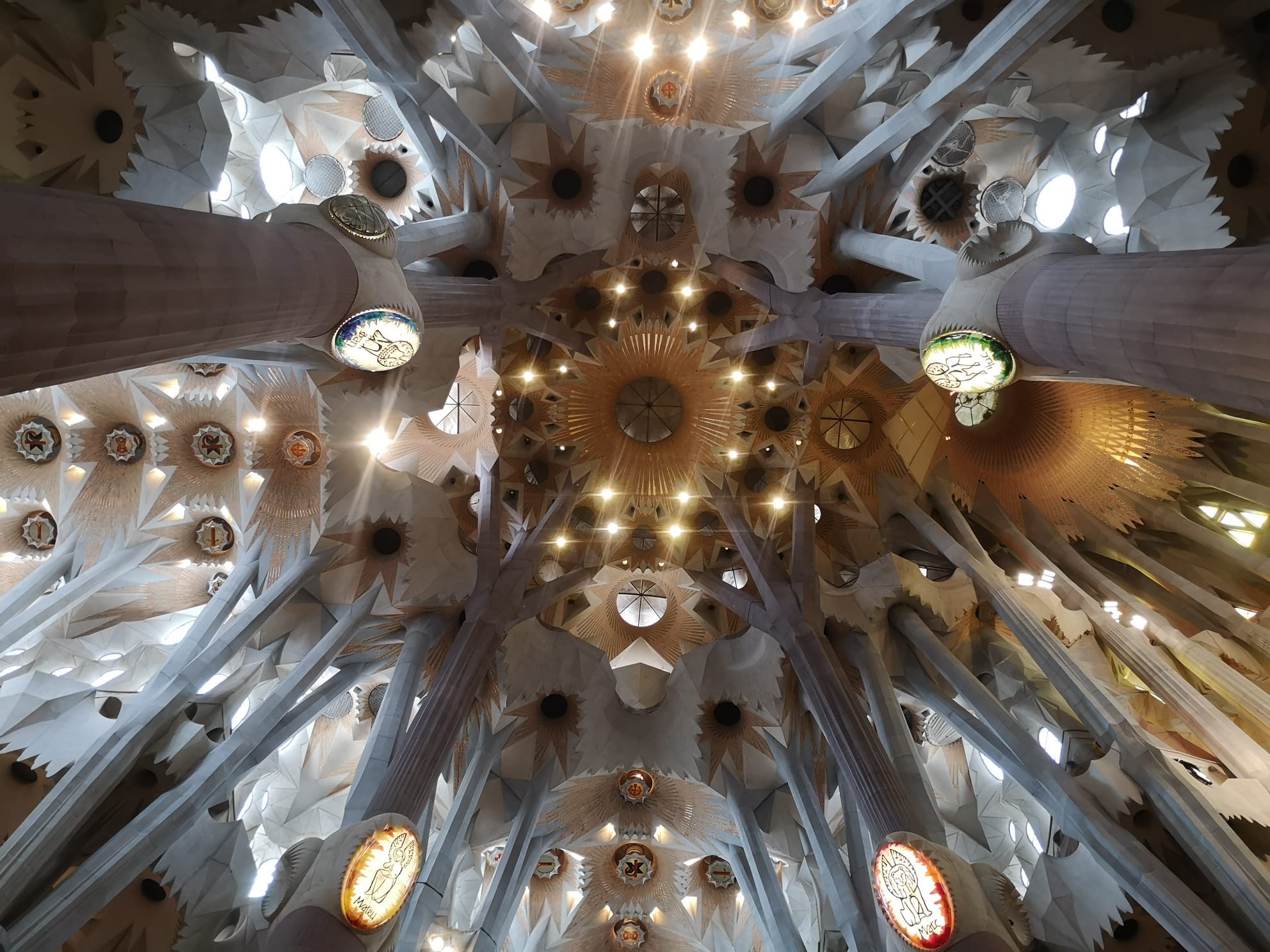
Could the Sagrada Família have inspired Rivendell? We can only speculate. However, it is undoubtedly due to this expressionist celebration of shared commons and nature as a holy entity that Art Nouveau has had such an influence on the world-building of the Elves in The Lord of the Rings, given their status as creatures beyond humanity, below the divine. Yet, it is also interesting to note that its predecessor — the Gothic style — was regarded by many 19th-century architects as the true German architectural style, deeply embedded in the cultural context in which J.R.R Tolkien lived and from which he drew inspiration, fruit of his profound knowledge of the myths and aesthetics of Northern Europe.
Beyond aesthetics, the architecture of Rivendell communicates a deeper philosophy: a commitment to coexistence, respect for the natural cycle, and a spiritual reverence for life itself, spatially translated in the harmonious relationship between the built environment and its surroundings.
The lightness, harmony and openness of Elvish dwellings can also be analyzed in contrast with other Middle Earth peoples’ habitats, highlighting the most prevailing traits of its inhabitants: the Dwarves’ dark, solid, rock-carved halls of Moria reflect their intimate connection with the earth and craftsmanship, while the Hobbits’ cozy, rounded homes express comfort and the pleasures of domestic living, grounded in the simplicity of a bucolic existence.
This differentiation showcases how architecture can be an active agent in world-building, transcending mere function and becoming a language of ideals and culture. In The Lord of the Rings, J.R.R Tolkien became the architect of a brilliantly constructed world, in which readers are invited to appreciate the variety of forms of living and the reflections of our own cultural heritage.