
Radical Optimism
Adversity as a catalyst for architectural imagination

Can building be an act of hope?
Architecture often finds its most urgent purpose in the collapse of failing systems.
Failure and reconstruction are inherent to the process of building and the development of human settlements; throughout history, human beings have shaped their environment in response to evolving physical needs, social structures, and political ideas, in cycles of growth and obsolescence.
Transformative periods often call for a renewed perspective, elevating the optimism inherently required in any act of building to a higher plane. At the heart of building, there is always an ambition to reshape our surroundings according to an ideal, a vision of a different world. This is noticeable in every intervention on the built environment; even a small renovation is an expression of a desire for beauty and a commitment to care. Such visions, even if utopian and ultimately unattainable, are guiding principles in our decision-making.
In this article, we will explore how challenging moments have become catalysts for architectural imagination, enabling new ways of thinking and making. Wars, natural disasters, and other violent upheavals are life-changing events that shake intellectual, moral, and aesthetic foundations, often unleashing profound individual and societal transformation. At those times, the role of architecture beyond the act of constructing buildings intensifies: it becomes a projective, critical, and potentially transformative cultural act. As both a political and creative discipline, architecture must respond to the zeitgeist and embrace its influence in the development of future societies.
The architectural toolkit carries both the capacity for imagining and the means for translating that imagination into real-world endeavours - either as gestures of hope, or as escapes in times of crisis.
Exponential Creativity: a theory of imagination by Bruno Munari
To understand how adversity can spark imagination, we’ll first have to understand what exactly imagination is - for that, we’ll turn to Bruno Munari’s theory of creativity. According to it, imagination is the mental operation that associates seemingly unrelated elements, endowing them with new attributes and meanings. This process draws upon our referential universe - our lived experiences, memories, and perceptions. Therefore, the more diverse our experiences, the richer our imaginative capacity.
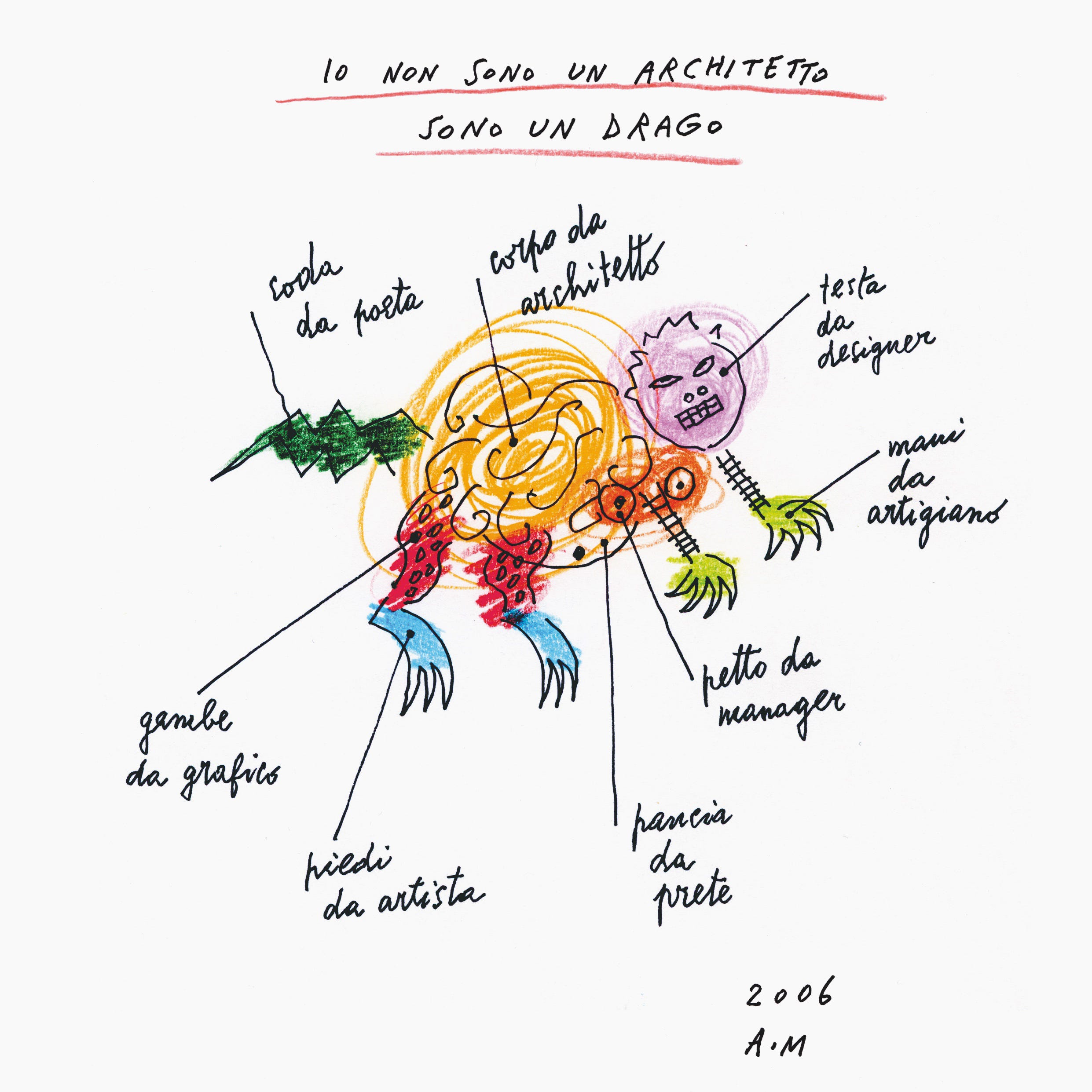
Creativity is described as the convergence of fantasy (the creation of things that do not and may never exist) with invention (the creation of new things with a functional or practical purpose). Architecture often sits at this intersection: a field where practical constraints meet future visions. Such a professional framework, paired with the experiential intensity of a life-changing event, has naturally led to changes in perspective in times of crisis. When faced with adversity, many architects respond by applying their professional abilities to the creation of new models - whether through idealistic approaches, or through practical reforms. Both methods, though distinct, remain essential references for thinking about architecture in times of rupture.
We will look into the legacy of three great architects whose trajectories were shaped by war - Bruno Taut, Walter Gropius, and Yona Friedman - to understand how their experiences translated into architectural production.
Beauty as an antidote to war – the perspective of Bruno Taut (1880-1938)
Bruno Taut was already engaged in socially conscious architecture when the First World War broke out. A pacifist, he refused military service and joined groups that were active in questioning the artistic and social functions of architecture. The experience of the conflict affected him profoundly, culminating in his breakthrough publication Alpine Architecture in 1918 - the year marking both the end of the war and the height of Europe’s devastation.
His disbelief in material and technological advancements - that he deemed responsible for the fabrication of weapons and machines that destroy humanity - led him to take a break from practical architectural work, filled with material constraints and political entanglements, and dedicate himself to drawing and writing.
If until the war he had used drawing mostly as a method for architectural projects, at that point, he recognized the potential of his talent as a tool for activism - and he used it, not as an escape from reality, but as a means to create better ones. He responded to the war by channeling his artistic talent into a new cause.
His work looked to translate the inherent struggles of the human condition through fantastic drawings and writings of visionary utopian landscapes, where aesthetics and religion were embraced as the true, meaningful human experiences.
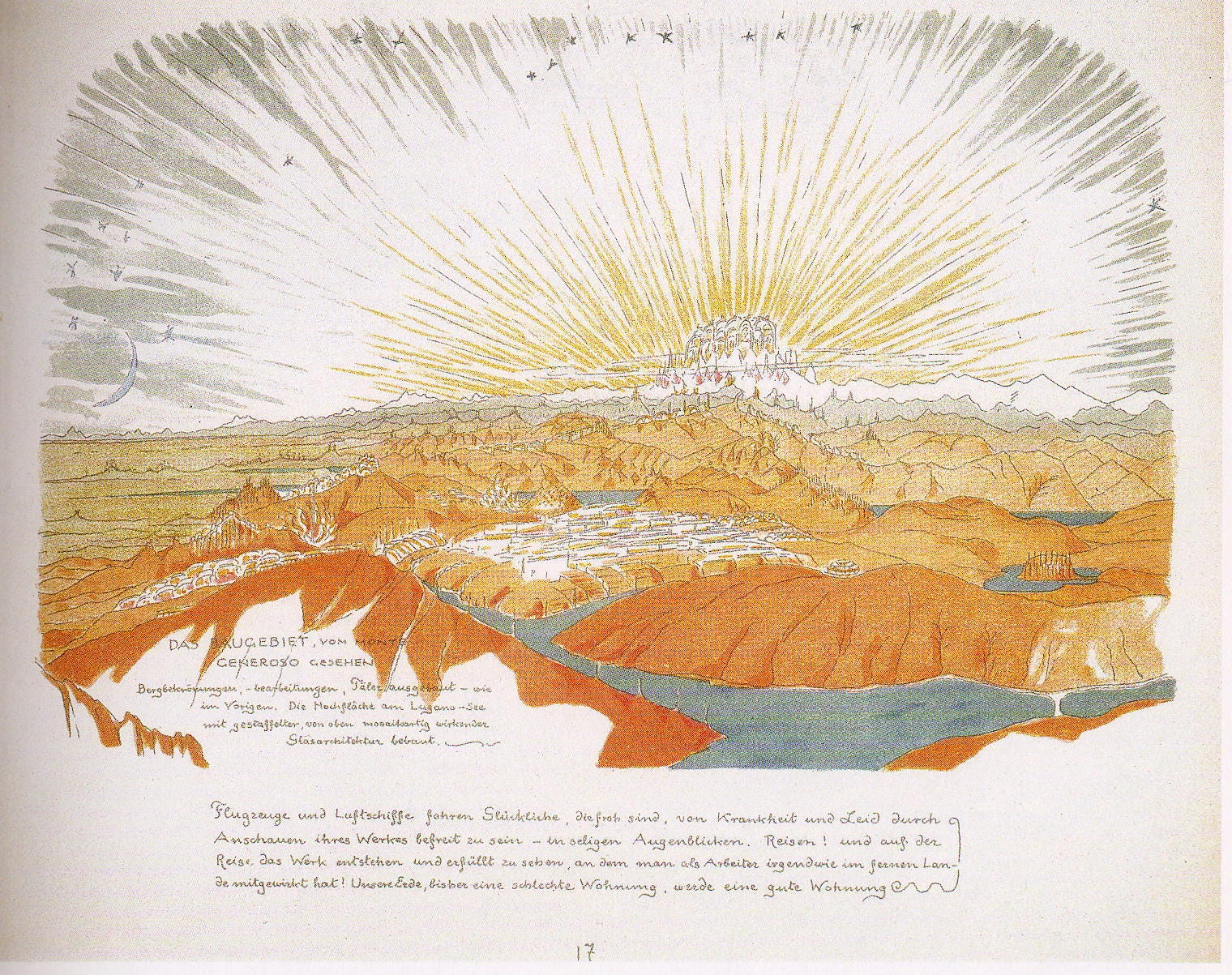
Alpine Architecture sets the portrait of a mountainous landscape, upon which crystalline, structureless buildings sit, as majestic, cathedral-like spaces of contemplation. They are assigned with no practical function, and no technical impairments; they were purely imagined as an aesthetic experience, places of spiritual elevation unbound by function or politics.
He asserted the feasibility of his alpine dream with a redirection of collective efforts - instead of wasting lives and funds in war endeavours, nations should abandon utility and eradicate conflict through cooperation in building, rather than destroying.
He explained the book as an antidote to war. To him, beauty became a form of resistance; it offered the possibility of liberating humanity from monstrous actions and reconnecting it to the deep living experience. The world would be redeemed through art - a spiritual encounter ignited by an awe-inspiring landscape and collective artistic endeavour.
Bruno Taut’s response to war was not to rebuild what had been lost, but to imagine a radically different world, one where architecture would unite humanity through wonder.
His vision was often dismissed as naive and idealistic; however, to those critical voices, he posed a question:
Impractical and unusable – but are we made happy from utility?
(Bruno Taut, Alpine Architecture)
Adaptation to changing times – the perspective of Walter Gropius (1883-1969)
Walter Gropius had started his own architectural practice, along with Adolf Meyer, a few years before the war. His previous experience working for Peter Behrens had included a comprehensive approach not only in architecture but also in design, designing both buildings and brand identity materials for clients. This experience equipped him with a solid understanding of marketing and business and a holistic vision of the architectural panorama.
He had already foreseen the need for a reform when, while still serving in the military as a soldier, he wrote to the Grand Duchy of Thuringia, with recommendations for a school that could provide artistic guidance to industry, addressing the problems of industrialisation in a society that was changing at a fast pace.
Shortly after, he would come to recognise a post-war shift: large commissions became rarer, young architects were organising in activist groups, and art’s role in society was being questioned. In a traumatised world with scarce resources, the ornamental elitism of traditional art no longer fit; affordable, functional solutions were required.
His vision was to unify the visual arts and architecture, promoting collaboration through workshops and a return to trade skills. He had the opportunity to fully develop it in 1919, when he became the founding director of the Bauhaus in Weimar. By merging the Academy of Fine Arts with the School of Arts and Crafts, Gropius redefined architectural education and fostered collaboration between artists, craftsmen, and industry.
The objects produced in the Bauhaus were characterised by geometric forms, primary colours, and simplicity. They were easily scalable and mass-produced, and fit for modern life and everyday people. In a turbulent time, offering standardized, systematic solutions helped achieve a maximization of resources that were already scarce.
The Bauhaus’ history is long and vast, and subject to a deeper essay; it does, however, intertwine with that of its creator, whose belief and vision for the future would forever change the architectural paradigm.
When faced with adversity, Walter Gropius foresaw and embraced the spirit of his time, actively advocating for change through practical reform, while leaning on form and function as tools to redesign a damaged world.
Embracing uncertainty – the perspective of Yona Friedman (1923-2020)
From an early age, Yona Friedman was acquainted with survival and resourcefulness. Born in Hungary, he fled during the war and lived as a refugee. His nomadic experience exposed him to the mutability of life, the scarcity of resources, and the limits of trusting architecture as a permanent refuge. He refused the mainstream approach to architecture as building for eternity; his perspective of architectural work was that of a continuous improvisation, shaped by trial and error.
Migration and reconstruction became recurring themes in his work, culminating in his architecture mobile concept and the idea of Ville Spatiale (the spatial city) - a continuum of posts above ground that would define empty space, where modules would be freely combined, that he describes as:
A structure having no floors, no walls, no roofs, nor any preconceived containers or shapes; that is the Ville Spatiale.
(Yona Friedman)
Unable to formally enrol at university as a Jew during WWII, Friedman attended any classes whose teachers allowed him in, including physics. There, he became acquainted with the uncertainty principle, which profoundly influenced his architectural thinking.
Unlike other architects who focused on gathering control through systems and planning, the fabric of Friedman’s architectural production was the unpredictability of life itself - as he put it, “a continuous improvisation”. He believed in the human ability for self-construction and for making decisions about the built environment, if provided with the right information and choice. His willingness to remove the power from the planner and give it to the user placed him close to libertarian ideals and inspired many architects to come, such as the incremental design of Elemental.
In an interview with Vladimir Belogolovsky, he explained:
You know, I am the product of the Second World War. I was only 21 when the world changed drastically. Everything I was taught at school did not work. I was in the resistance in Budapest at the end of the war and was taken as a prisoner by the Gestapo. But I survived. The winter was brutal. There was no water, no electricity, no heating. Windows had no glass. There were one million inhabitants and people survived. I realized then that our habits and customs are very fragile. So I thought about finding a certain autonomy, and autonomy comes with improvisation. (…) In architecture, the whole idea should be to find ways to adapt to reality. This idea came from my own reaction to the catastrophe.
(Yona Friedman)
In his view, architecture alone could not “create a world”; this task could only be achieved by relying on imagination and critique equally. He did so by embracing adversity and the unpredictability of life in order to face it, challenging the conventions of space, time, and gravity, allowing architecture to expand beyond mass and materialize through the inputs of those who lived in it. When faced with adversity, he responded by cherishing human nature and fighting the perceived immutability of structures, all while building with the fabric of life itself.
Contemporary optimistic landscapes
Architecture’s engagement with adversity is as much about rethinking society as it is about reimagining space. Adversity can trigger a variety of responses, from artistic questioning to systemic educational reforms to developing new frameworks.
In the face of today’s overlapping global crises - wars, environmental challenges, mass displacement, and the aftermath of a pandemic - architecture retains its vital role as a generator of questions, scenarios, and possibilities. The architectural imagination is continuously reinvented, fueled by surroundings that act as both warnings and opportunities - places to regenerate, coexist, and resist.
Our present challenges are prompting contemporary architects to imagine new spatial and social arrangements, such as:
Politics of degrowth and repair: circular construction strategies and sustainable practices are a direct, active response to the confrontation with ecological crisis and the flaws of linear economic models for the built environment;
Community development: an increasing number of architectural interventions aim for growth at a local scale, adopting context-based solutions that promote regional economic development and agency, against a trend of globalization and standardized solutions;
Adaptive reuse: the shift from industry to tertiary and quaternary economic sectors in recent decades has left empty lands behind. The reintegration of these places (mostly, post-industrial ruins and urban voids) in the urban fabric is not merely aesthetic recycling, but a redefinition of values;
Alternative housing models: the current variations in population, mass displacements, and economic pressures have been pressing architects to rethink housing models, adapting them to ongoing societal changes.
Optimism, in this sense, exists in every idea or action that seeks to leave the world better than before, questioning the status quo and seeking better life conditions for generations to come.
Learning from the architects who endured challenging times and whose work became a symbol of resilience and resistance, we should become better equipped to trust our own capabilities while designing for an ever-changing and unpredictable world.
Imagination can offer escape, critique, repair, or possibility, but every small action transforms adversity into intention, opening the system to the possibility of building differently. At times when systems collapse and one is forced to look inwards, the words that Bruno Taut wrote to his brother Max, back in 1918, may still resonate:
How loathsome politics now are!
But I shan’t run away, my radiant world lives within me.
(Bruno Taut)